

Trong hệ thống ngữ pháp, danh từ trong tiếng Anh đóng vai trò là một trong những thành phần câu cơ bản và quan trọng nhất. Việc hiểu rõ cấu trúc và tính chất của danh từ trong tiếng Anh không chỉ giúp bạn xây dựng câu chuẩn xác mà còn nâng cao kỹ năng làm bài thi ngữ pháp. Focus Learning sẽ tổng hợp đầy đủ và chi tiết toàn bộ kiến thức về danh từ trong tiếng Anh giúp học sinh dễ dàng nắm vững.
Danh từ trong tiếng Anh là gì?
Danh từ trong tiếng Anh (Noun – viết tắt là N) là từ dùng để chỉ người, sự vật, vụ việc, nơi chốn, hiện tượng hoặc các khái niệm trừu tượng. Trong ngữ pháp, danh từ trong tiếng Anh giữ các vai trò chính như làm chủ ngữ, tân ngữ hoặc bổ ngữ trong câu.
Các nhóm danh từ trong tiếng Anh phổ biến bao gồm:
- Chỉ người (Person): teacher, student, doctor, engineer…
- Chỉ nơi chốn (Place): school, park, hospital, London, Vietnam…
- Chỉ sự vật / động vật (Thing / Animal): pen, book, table, dog, cat…
- Chỉ hiện tượng / khái niệm (Phenomenon / Concept): rain, storm, happiness, freedom, knowledge…
Ví dụ:
- The teacher is explaining the lesson to the students. (teacher, lesson, students là các danh từ)
- Hanoi is the capital of Vietnam. (Hanoi, capital, Vietnam là danh từ)
Cách nhận biết danh từ trong tiếng Anh
Để nhận biết danh từ trong tiếng Anh một cách nhanh chóng khi làm bài tập chia từ loại (Word Form), học sinh có thể căn cứ vào các hậu tố (suffixes) đặc trưng ở đuôi từ:
Hậu tố chỉ người:
- -er / -or: teacher, worker, actor, doctor, director
- -ist: scientist, dentist, pianist, artist
- -an / -ian: musician, politician, technician
- -ee: employee, interviewee, trainee
Hậu tố chỉ sự vật, khái niệm, tính chất:
- -tion / -sion: education, decision, information, action
- -ment: development, management, environment, movement
- -ness: happiness, sadness, kindness, darkness
- -ity / -ty: ability, activity, reality, priority
- -ance / -ence: importance, difference, performance, attendance
- -ship: friendship, leadership, scholarship
- -hood: childhood, neighborhood, brotherhood
- -ism: patriotism, optimism, criticism
- -dom: freedom, wisdom, kingdom
Vị trí của danh từ trong câu
Việc nắm rõ vị trí của danh từ trong tiếng Anh sẽ giúp bạn xác định đúng từ loại cần điền trong các bài thi. Dưới đây là bảng tổng hợp các vị trí thường gặp:
| Vị trí của danh từ | Cấu trúc ngữ pháp | Ví dụ thực tế |
|---|---|---|
| Đứng đầu câu làm Chủ ngữ (S) | Noun + Verb | Books broaden our knowledge. |
| Đứng sau Động từ làm Tân ngữ (O) | Verb + Noun | She bought a new laptop yesterday. |
| Đứng sau Giới từ làm tân ngữ giới từ | Preposition + Noun | He is very interested in music. |
| Đứng sau Mạo từ / Tính từ sở hữu / Từ chỉ số lượng | a/an/the/my/many… + Noun | A garden; My family; Many students. |
| Đứng sau Tính từ bổ nghĩa | Adjective + Noun | They live in a big house. |
| Đứng sau Động từ nối (Linking Verb) làm Bổ ngữ | Linking Verb + Noun | My father became a famous doctor. |
Các loại danh từ trong tiếng Anh
Danh từ trong tiếng Anh được chia thành 4 loại chính dưới đây, các bạn hãy cùng tìm hiểu cả bốn loại để có thể áp dụng thật tốt nhé
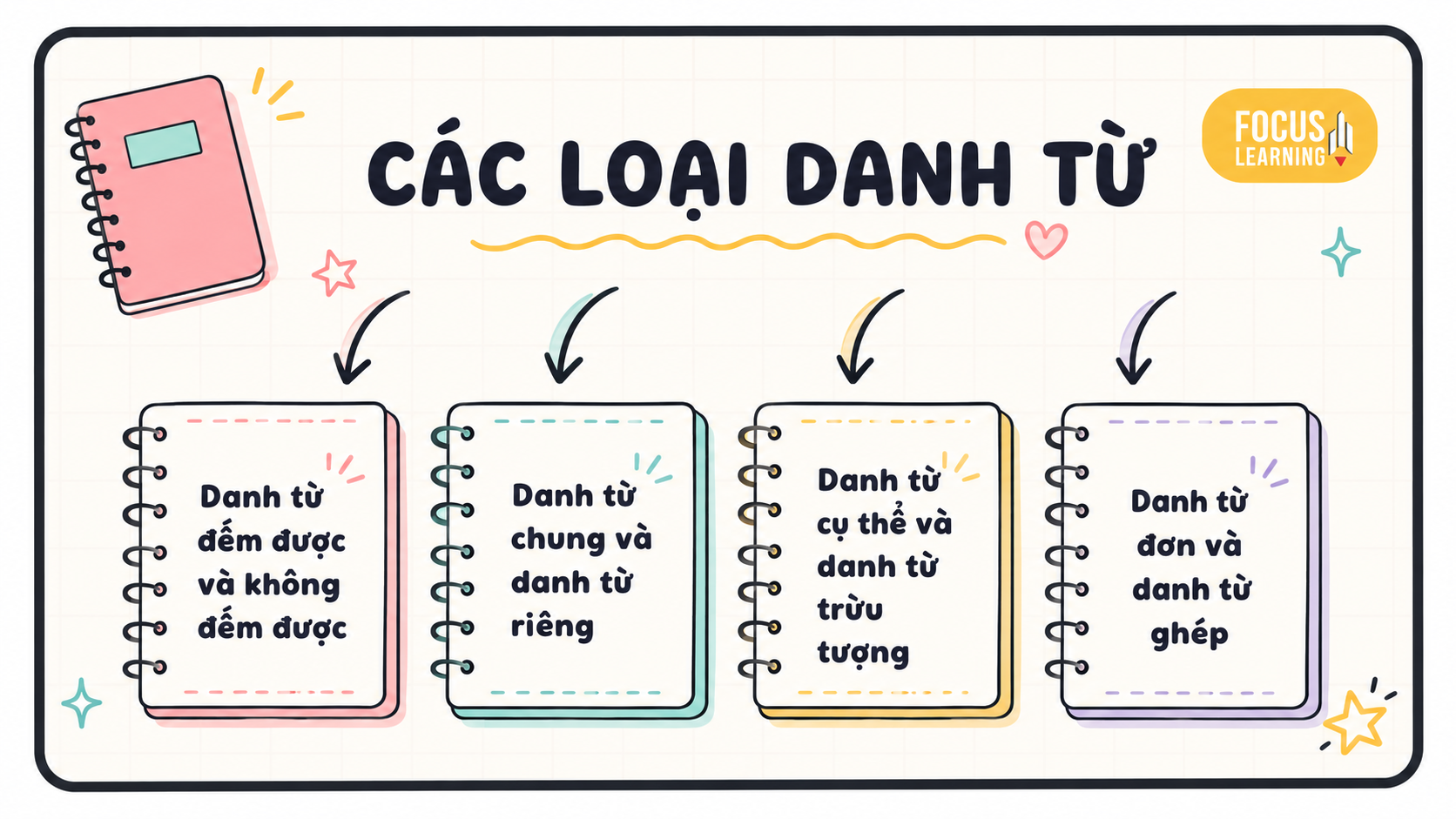
Danh từ đếm được và không đếm được
Danh từ trong tiếng Anh đếm được (Countable Nouns): Dùng chỉ sự vật có thể đếm bằng số đếm trực tiếp.
- Danh từ số ít (Singular): Đi kèm với a/an (a pen, an apple).
- Ví dụ: There is an apple on the table.
- Danh từ số nhiều (Plural): Thêm -s/-es (pens, apples) hoặc dạng bất quy tắc (man ➔ men, child ➔ children, tooth ➔ teeth, phenomenon ➔ phenomena).
- Ví dụ: Two children are playing with their dogs in the yard.
Danh từ trong tiếng Anh không đếm được (Uncountable Nouns): Chỉ chất lỏng, khái niệm trừu tượng, chất khí, hạt nhỏ (water, rice, money, information, advice, furniture). Những từ này không đi với a/an hay số đếm trực tiếp và luôn chia động từ ở dạng số ít.
- Ví dụ: Could you give me some information and advice?
Danh từ chung và danh từ riêng
- Danh từ chung (Common Nouns): Tên gọi chung cho một loại người, sự vật hoặc nơi chốn (city, country, dog, school).
- Ví dụ: The boy is studying at a famous university.
- Danh từ riêng (Proper Nouns): Tên riêng của cá thể, địa danh hoặc tổ chức (Tokyo, Vietnam, John, Google). Danh từ riêng luôn phải viết hoa chữ cái đầu tiên.
- Ví dụ: John moved to Tokyo to work for Google.
Danh từ cụ thể và danh từ trừu tượng
- Danh từ cụ thể (Concrete Nouns): Chỉ những sự vật, con người có thể cảm nhận bằng 5 giác quan – nhìn, nghe, ngửi, nếm, sờ (table, flower, perfume, song).
- Ví dụ: The sweet aroma of fresh coffee filled the room.
- Danh từ trừu tượng (Abstract Nouns): Chỉ các khái niệm, cảm xúc, ý tưởng hoặc phẩm chất không thể tiếp xúc vật lý (love, courage, honesty, beauty, freedom).
- Ví dụ: Honesty and patience are essential virtues for success.
Danh từ đơn và danh từ ghép
- Danh từ đơn (Simple Nouns): Chỉ gồm một từ đơn lẻ (book, house, river).
- Danh từ ghép (Compound Nouns): Được tạo thành từ hai hay nhiều từ kết hợp lại với nhau (Noun + Noun, Adjective + Noun, Verb + Noun, Noun + Preposition…).
- Ví dụ: She put her clothes into the washing machine before clean her teeth with toothpaste.
Bài tập danh từ trong tiếng Anh
Bài 1: Cho dạng đúng của từ trong ngoặc
1. The rapid (DEVELOP) ________ of renewable energy sources is essential for environmental protection.
2. Several (PHENOMENON) ________ were observed during the astrophysics experiment last night.
3. The board of directors appreciated her outstanding (LEAD) ________ during the crisis.
4. Many young graduates face severe financial (HARD) ________ when looking for their first job.
5. Extensive research has confirmed the (EFFICIENT) ________ of the new medical treatment.
6. Environmentalists are working hard to preserve biodiversity and protect endangered (SPECIES) ________.
7. Due to a lack of clear (EXPLAIN) ________, many students failed to complete the assignment correctly.
8. Historical documents require careful (PRESERVE) ________ to prevent long-term degradation.
9. All applicants must meet the minimum (REQUIRE) ________ set by the admission committee.
10. His brilliant (CRITIC) ________ of the modern economy was published in a prestigious journal.
Đáp án
1. development
2. phenomena
3. leadership
4. hardships
5. efficiency
6. species
7. explanation
8. preservation
9. requirements
10. critique / criticism
Bài 2: Phân loại các loại danh từ và tìm lỗi sai
1. She provided us with many useful advices regarding our university applications.
2. The company is seeking innovative solutions to improve employee satisfy.
3. Hundreds of passbys witnessed the dramatic street performance yesterday afternoon.
4. Modern agricultural techniques have significantly increased crop produce in rural areas.
5. The committee reached a unanimous decide after hours of intense deliberation.
6. Mathematical calculations require high precision and absolute accurate.
7. Fresh air, clean water, and fertile soil are valuable natural resource that we must protect.
8. The government has implemented new policies to stimulate economic grow.
9. They spent a considerable amount of moneys on renovating their historic mansion.
10. Lack of proper sleep can negatively affect your academic perform at school.
Đáp án
1. advices -> advice
2. satisfy -> satisfaction
3. passbys -> passers-by
4. produce ->production
5. decide ->decision
6. accurate -> accuracy
7. resource -> resources
8. grow -> growth
9. moneys -> money
10. perform -> performance
ĐĂNG KÝ NHẬN TƯ VẤN NGAY